Course Catalog

Approved and endorsed by CSCMP, we combine educational technology
with a dynamic curriculum to help learners achieve deep learning of logistics concepts.

Browse By:

Documentation

2 Lessons
$85

Key Import Documents

  • Functions of a bill of lading
  • Commercial invoice requirements and information for entry summary
  • Personal and household goods documentation
read more
2 Lessons
$85

Basics of Air Waybills

  • Basics of air waybills
  • Preparation and issuance of air waybills
  • Review of air waybill functions
read more
5 Lessons
$95

Air Waybill Information Fields

  • Air Waybill Information Fields
  • Correct input into an air waybill
  • Distribution of air waybills
read more
5 Lessons
$95

U.S. Domestic Bill of Lading (Using Text)

  • Understand the fundamental role and functions of the Bill of Lading (BOL) in both inbound and outbound logistics.
  • Optimize logistics operations by effectively managing and utilizing the Bill of Lading.
  • Navigate regulatory and compliance requirements associated with the Bill of Lading, including potential issues that can arise from incorrect usage.
read more
4 Lessons
$95

U.S. Domestic Bill of Lading (Using Video)

  • Understand the fundamental role and functions of the Bill of Lading (BOL) in both inbound and outbound logistics.
  • Optimize logistics operations by effectively managing and utilizing the Bill of Lading.
  • Navigate regulatory and compliance requirements associated with the Bill of Lading, including potential issues that can arise from incorrect usage.
read more
2 Lessons
$85

Import-Export Documents for DG, Animals, Plants, & Other Related Factors

  • Why destination country officials may order the arriving transportation conveyance not to unload a shipment that arrives without required product-based documentation.
  • The two types of documents that destination country customs authorities will require for clearance of dangerous goods
  • Why an exporter and its forwarder should not rely solely on the importer informing as to what product-based import requirements are required for the exporter’s product in the destination country
read more
3 Lessons
$85

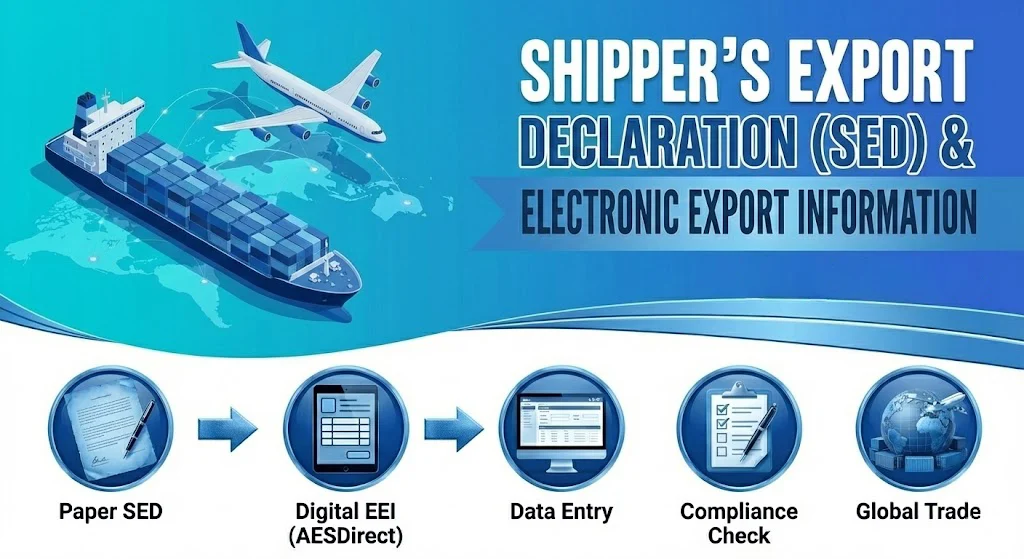
Shipper’s Export Declaration (SED) and Electronic Export Information (EEI)

  • Determine when EEI filing is required under FTR, including license-controlled and special exports.
  • Identify EEI filing exemptions and understand when they do not apply.
  • Apply filing rules for shipments involving BIS, DDTC, DEA, NRC, and high-risk destinations.
  • Differentiate AES Exemption vs. Exclusion Legends and apply them correctly.
  • Interpret value-based EEI exemptions and aggregation rules for frequent shippers.
  • Identify EEI exemptions for personal effects, household goods, and miscellaneous shipments.
  • Explain USPPI responsibilities and provisions for routed exports under 15 CFR 758.3.
  • Classify items with the CCL and identify correct ECCNs for licensing and EEI.
  • Summarize EEI confidentiality rules and penalties for unauthorized disclosure.
read more
1 Lessons
$85

Cargo Insurance and Trade Finance Documentation

  • Understand the forwarder’s role in managing cargo risk
  • Understand a forwarder’s responsibilities when providing services involving foreign collection for the value of goods being shipped.
  • Understand the procedures for documentary and letter of credit transactions
read more
2 Lessons
$85

Basics of Certificates of Origin

  • The two purposes of a certificate of origin
  • How country of origin of a product is determined, and unavoidable complexity that sometimes arises
  • How rules of origin vary based on the destination country and whether a free trade agreement exists between the origin and destination countries
read more
4 Lessons
$95

Letters of Credit and Foreign Collection Documentation

  • Understand the role of letters of credit in ocean shipments, including the importance of consistent cargo descriptions and timely B/L dates.
  • Recognize the impact of payment terms, letter of credit requirements, and documentary drafts on routing, carrier selection, and bill of lading instructions.
  • Learn the rules and best practices for the distribution of shipping documents, ensuring timely delivery to relevant parties, including under letters of credit and documentary drafts.
  • Know the responsibilities of a forwarder in distributing shipping documents, including customs clearance and document distribution for shipments under ATA carnets.
  • Understand the options and record-keeping requirements for the physical distribution of shipping documents, including collections made through carriers or documentary draft collections.
read more